Mobile Collaborative Robot (AMR + Cobot): Enhanced Autonomy for Material Handling
Quick Facts
Technology Performance Metrics
⭐Key Features
Benefits
Applications
Detailed Information
Technology Overview
The combination of an Autonomous Mobile Robot (AMR) with a collaborative robot (cobot) represents a significant evolution in flexible automation. This integrated system, often called a mobile manipulator or mobile cobot, merges the safe, user-friendly interaction of collaborative robots with the free-roaming navigation capabilities of AMRs. While stationary cobots excel at repetitive tasks within a fixed work envelope, adding mobility dramatically expands their potential application range. This fusion is designed to tackle material handling and light manipulation tasks that require movement across a warehouse or factory floor. By granting cobots the ability to travel autonomously to different points of need, this technology aims to create new levels of operational efficiency and re-define the division of labor between humans and machines.
How It Works
Core Principles
The core principle is Mobility-Enhanced Collaboration. The system leverages the AMR as an intelligent, self-navigating platform that carries the cobot to various task locations. At each location, the cobot—equipped with force-limited joints and often vision guidance—performs its designated manipulation task, such as picking, placing, or loading/unloading. The collaboration is twofold: between the mobile platform and the arm, and between this combined system and human workers who share the workspace.
Key Features & Capabilities
Autonomous Mobility for Manipulation Tasks is the defining feature. This capability allows a single robotic arm to serve multiple workstations or a large area, effectively multiplying its utility compared to a fixed installation.
Inherent Collaborative Safety is maintained. The cobot component is designed to work safely around people, and the AMR typically includes safety sensors (LiDAR, cameras) to navigate safely in dynamic environments. The combined system is intended to operate in shared spaces.
High Degree of Operational Autonomy is a key goal. Once tasked, the system should perform the complete sequence of travel, pick, transport, and place with minimal human supervision, only requiring intervention for exceptions or recharging.
Advantages & Benefits
The primary advantage, as stated, is Reduced System Downtime. Adding mobility means the valuable manipulation asset (the cobot) is not idle waiting for work to come to it. It can be continuously utilized by moving to where the work is, significantly improving asset utilization and overall throughput.
It Unlocks New Efficiencies in Material Handling. By automating the entire process of fetching and delivering items between points, it eliminates the waste associated with manual transport using carts or forklifts, and the waiting time associated with fixed conveyor routes.
This technology Empowers Human Workers. By offloading repetitive, mundane transport and handling tasks to the mobile cobot, human workers are freed to focus on higher-value activities that require judgment, dexterity, or problem-solving skills, leading to better job satisfaction and productivity.
Implementation Considerations
Integration Complexity and Programming is a significant factor. Successfully merging the control systems of an AMR and a cobot into a seamless workflow requires specialized expertise. Programming tasks that involve coordinated movement and manipulation adds a layer of complexity beyond using either robot alone.
Payload and Stability Constraints must be carefully calculated. The AMR must be sized to carry not only the weight of the cobot itself but also the maximum expected payload the cobot will handle, all while maintaining stability during arm movement and mobile transit.
Workplace Design and Safety Validation is crucial. The routes the AMR will travel must be clear and well-defined. A thorough risk assessment is needed to ensure the combined mobile manipulator operates safely in its intended collaborative environment, considering both navigation and manipulation hazards.
Conclusion
The mobile collaborative robot (AMR + Cobot) is a powerful and flexible automation solution for environments that require both mobility and precise manipulation. It is ideal for applications like machine tending, kitting, light assembly supply, and inter-station transfer where tasks are distributed across a facility. Its greatest strength is the dramatic increase in autonomy and utilization it offers over stationary automation. However, this comes with increased complexity in integration, programming, and safety planning. For businesses with variable workflows, distributed processes, and a desire to automate material movement without massive fixed infrastructure, this technology offers a compelling path forward. Success requires a clear understanding of the specific tasks to be automated and a partnership with integrators who can effectively unite the mobility and manipulation domains.
Related Knowledge
Robotic Case Picking
Advanced robotic case picking systems that combine industrial robotics with intelligent vision systems to automate the handling of full cases and cartons, delivering exceptional speed, precision, and reliability in high-volume distribution operations.
Robotic Piece Picking
Advanced robotic systems that use AI and computer vision to automatically select and pick individual items from diverse inventory, revolutionizing warehouse fulfillment operations with human-like dexterity and intelligence.
Voice Picking Systems
Voice picking systems revolutionize warehouse operations by enabling hands-free, eyes-free order fulfillment through speech recognition technology. Workers receive spoken instructions through wireless headsets and confirm actions verbally, dramatically improving productivity, accuracy, and safety while reducing training time.
Vendor
OthersRelated Technologies
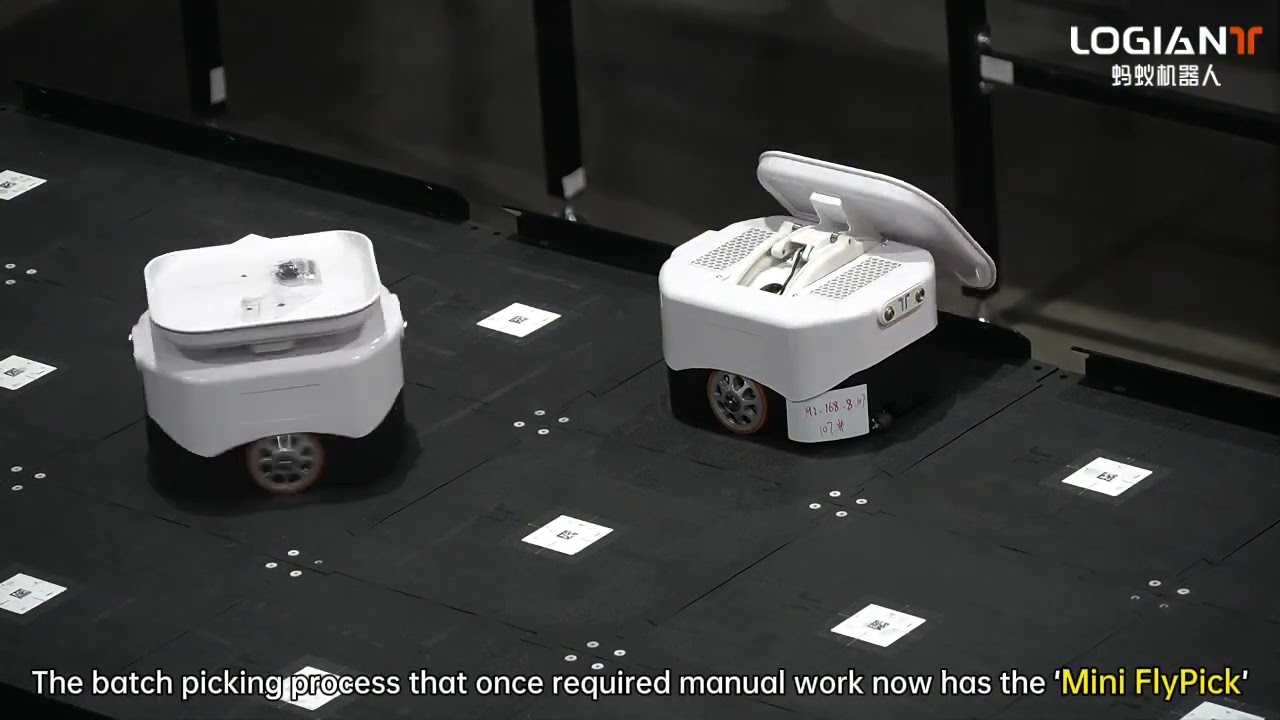
Mini FlyPick Robot: Compact High-Speed Sorting AMR
Others

Split Tray (Bomb Bay) Sorter Compilation: Versatile High-Speed Sortation
Others
Patented Dual Split Tray (Bomb Bay) Sorter with Batch Induction
Others